
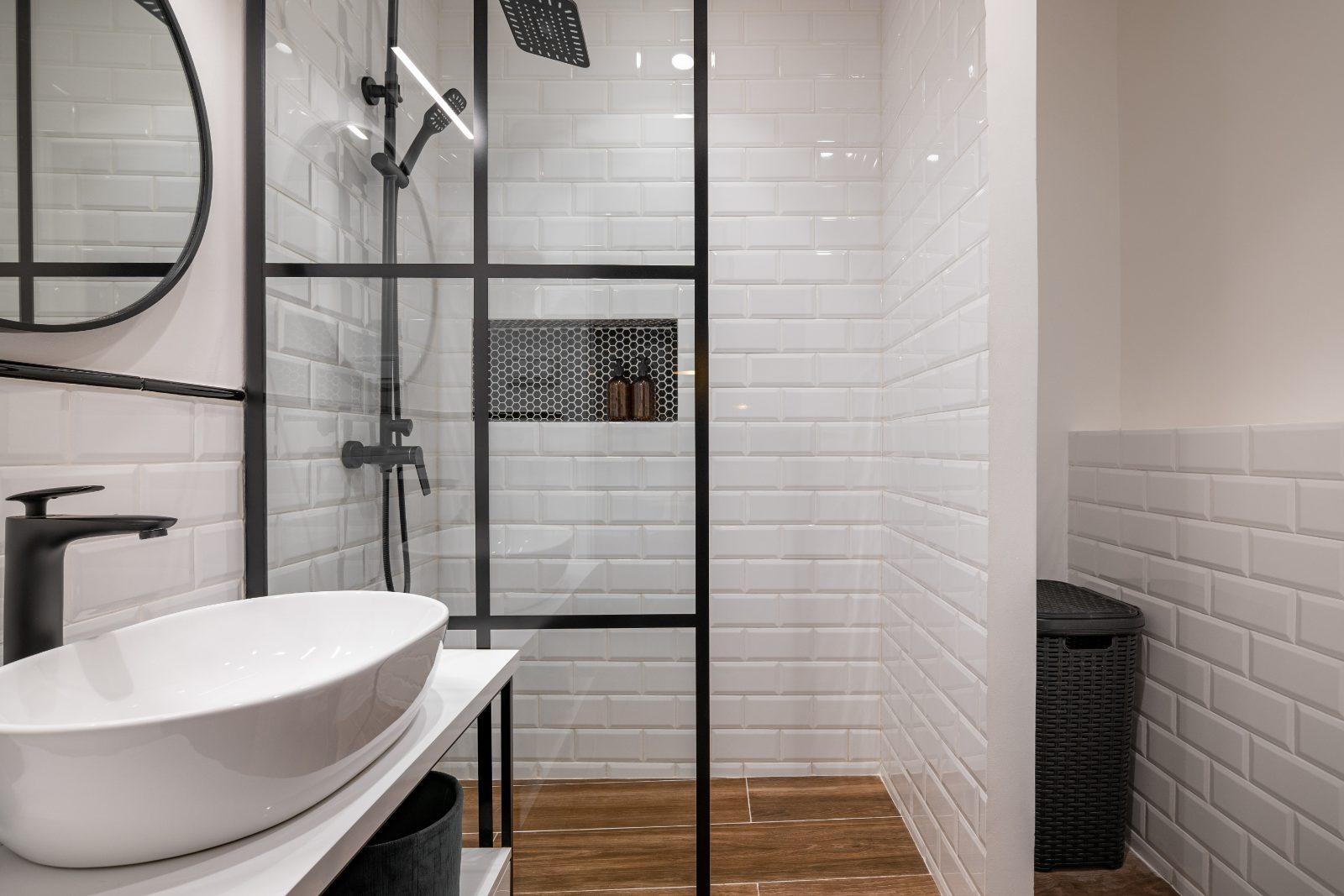
Run a finger down your bathroom mirror and nothing comes off. Catch the same mirror at four in the afternoon, when the light arrives sideways, and you see something else entirely: a soft haze lying across the whole surface, with a few dried splashes set into it like fossils.
Glass indoors does not really get dirty. It gets coated. And because the coating is thin, even and properly stuck down, a quick dry wipe polishes it rather than removing it — which is why the mirror looks fine in the morning and terrible by teatime. Here is what is actually on there, and what shifts it.
Your windows face the outside world and collect what it sends: road dust, rain marks, the fine film that settles after a hazy week. The glass inside your flat faces you instead, which turns out to be harder work.
Three things do most of the damage. Aerosols drift — deodorant, hairspray, dry shampoo and kitchen spray all travel much further than the thing you aimed them at, and settle as a tacky layer you cannot see until the light is wrong. Steam carries soap, skin oils and dissolved minerals up onto the nearest cold surface, then evaporates and leaves all of it behind. And hands contribute a little oil every single time someone pushes a glass door.
Our climate makes each of these worse. Surfaces stay damp for longer here, so deposits have more time to settle and bond instead of drying off and brushing away, and a bathroom with no window can hold its steam for the better part of an hour.
Two cloths, not one. A damp microfibre to lift the film, a dry microfibre to buff it off before it air-dries. Almost everything else is detail.
Wring the damp cloth out properly — it should feel barely wet — and work in overlapping passes from the top down, so nothing drips onto glass you have already done. Follow immediately with the dry cloth. Streaks are almost always a drying problem rather than a product problem.
For dried toothpaste spatter, lay the damp cloth flat over the spots for half a minute and let them soften. Scraping with a nail or anything hard is how mirrors pick up fine scratches that catch the light forever afterwards.
One rule is worth more than all the others: never spray liquid straight at the edges of a mirror. It wicks in behind the backing, and once the silvering starts to lift you get those creeping black blotches at the corners. No amount of cleaning brings those back. Spray the cloth, never the glass.
The screen carries a different film — soap and minerals together, laid down in layers over months. Warm water and a mild cleaner left to sit for a minute or two will do far more than the same cleaner scrubbed on and wiped straight off. Give it time to work, then take it off with a squeegee in long strokes.
The parts everyone misses are the bottom channel the door sits in and the rubber seal along its edge, both of which hold water and quietly go grey. The sealant line where the screen meets the tiles is the one to watch: if the dark staining is inside the silicone rather than sitting on top of it, you are past what a cloth can reach, and into mould removal territory.
Once you start noticing the film, you find it well outside the bathroom.
The same two cloths work on all of them. The oven door is the exception: that grease wants a proper degreaser and a few minutes of patience before any wiping starts.
Some glass has gone past cleaning in the ordinary sense. If a shower screen still looks cloudy when it is completely clean and completely dry, the minerals have etched into the surface itself, and that is a replacement conversation rather than a cleaning one.
Far more often, though, the problem is simply scale. A flat has a surprising amount of glass in it, most of it in awkward spots, and catching up on three years of film in one weekend is nobody's idea of a Saturday. That is the point at which it makes sense to hand the whole lot over — a deep clean to reset the surfaces that have stopped responding, and regular housekeeping afterwards so they never get that far again.
Either way, start tonight with the mirror: two cloths, five minutes. And if the rest of the glass in the flat is further gone than that, you can always book your next clean and let someone else do the reaching.


