

There is a particular pride in a houseplant that survives. In a flat where the aircon runs most evenings and the balcony takes four hours of hard afternoon sun, keeping a monstera alive for three years is a genuine achievement, and we display it accordingly: by the window, on the sideboard, in the corner that was looking a bit bare.
What nobody mentions is that a thriving plant is a small, slow, continuous event. It sheds. It drips. It breathes moisture into the air around it. Everything it does lands on something — a leaf, a shelf, a skirting board, a floor. If a plant is doing well, something underneath it is usually doing well too, and that something is rarely as welcome.
Dust does not only settle on tables. A mature rubber plant or a good-sized monstera offers a surprising amount of flat, horizontal, slightly waxy surface, and in a home with windows open to city air it collects a film faster than you would guess. You usually notice it by accident — brushing past on the way to the clothes rack and coming away with grey on your sleeve.
A damp microfibre cloth, one leaf at a time, supported from underneath so nothing snaps, sorts it out. The plant benefits too, because dust blocks the light it is trying to use. The part people forget is where that dust goes next: straight down, onto the floor, the skirting and whatever furniture is within half a metre. Wiping leaves is really a two-stage job, and the second stage happens at ground level.
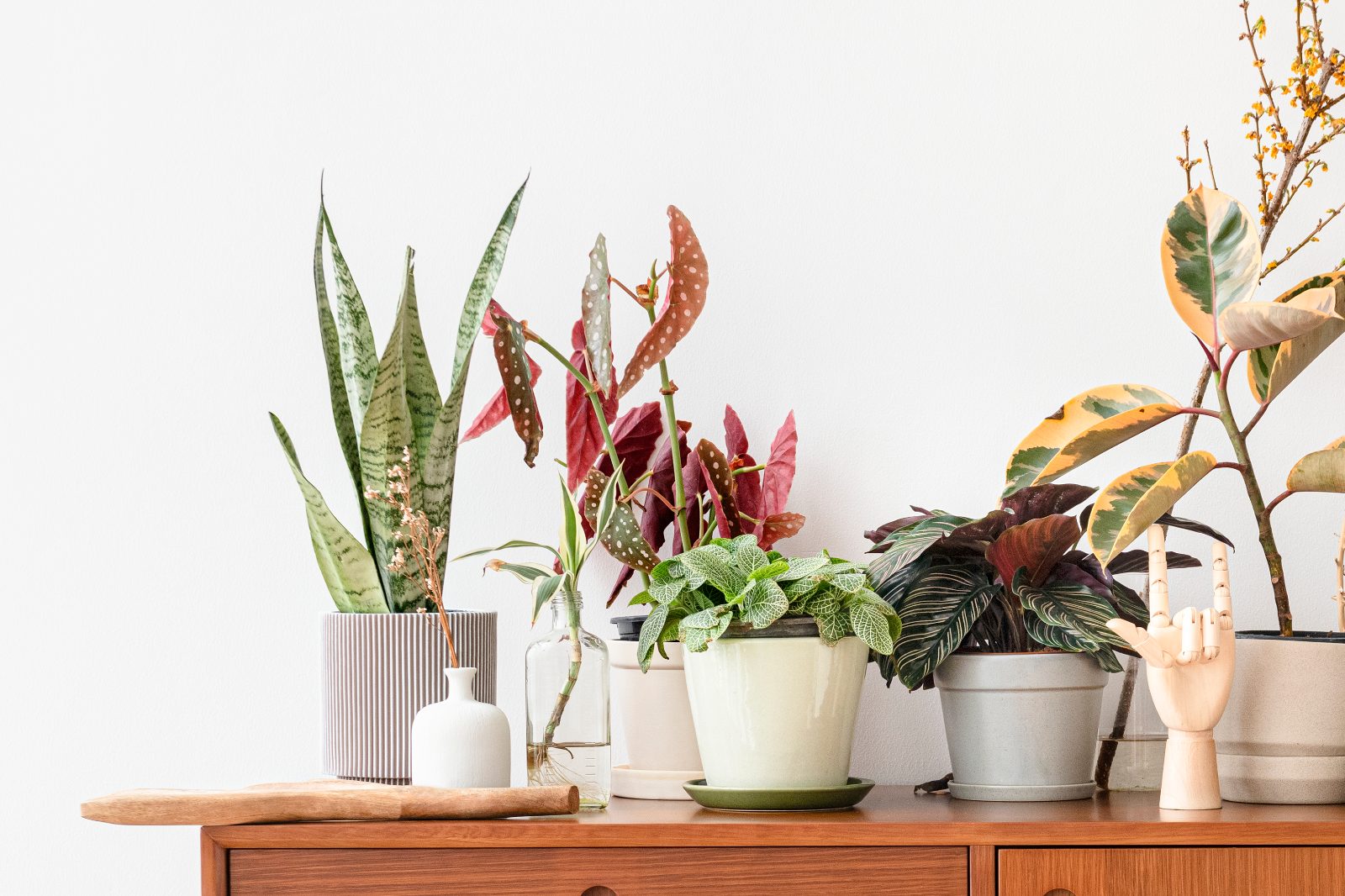
The saucer exists to protect the surface underneath, and it does — right up until it doesn't. Water collects, sits, and slowly evaporates, leaving a chalky ring of minerals behind. Meanwhile the base of the pot stays permanently damp, and that dampness does not stay inside the saucer. On timber it lifts the finish. On tile it works into the grout lines, which is why the ring is still faintly visible long after you have wiped it. Grout is porous, holds what soaks into it, and does not respond to a mop — it wants mechanical agitation, which is the sort of thing a floor deep clean is built around.
Standing water in a saucer has a second problem, and in Singapore it is everybody's business rather than just yours. Mosquitoes need very little water and not much time. Tipping out the saucers takes about a minute a week and removes the whole question.
Then there is the potting mix. Fine soil migrates — down the side of the pot, across the tile, into grout joints and the gap where the skirting meets the floor. It is too fine to sweep properly and too dark to see against most flooring, so it quietly accumulates in exactly the places a vacuum nozzle cannot reach.

Plants tend to be put wherever nothing else fits: behind the sofa, in the dead corner by the service yard door, at the blind end of the corridor. Those are precisely the spots where air stops moving. Add something that releases moisture all day, press it against a painted wall, and you have built a small humid microclimate in the one part of the room nobody looks at.
So look at it. Pull the pot forward thirty centimetres and check the wall behind, the skirting and the back of the pot itself. Chalky white is usually harmless mineral residue. A soft grey or black bloom spreading outward is not, and painting over it only hides it for a few months — that is a job for proper mould removal, done at the surface rather than over it. While the pot is out of the way, give the wall and floor behind it the wipe they have not had since the plant arrived, and leave a finger's gap when you push it back so air can get round.
None of this is an argument against houseplants. It is an argument for occasionally treating them as furniture rather than decoration — things that sit on surfaces, shed onto floors and change the air around them. Wipe the leaves this evening, tip out the saucers, and shift one pot to see what has been living behind it. For the rest of it — the grout, the skirting line, the corners that every piece of furniture in the flat is quietly hiding — that is what regular housekeeping is for. When you want it handled properly, you can book your next clean in a couple of minutes.


