

The toilet is probably the thing in your flat you clean most often and look at least. A squirt round the bowl, a brush, a flush, done. Thirty seconds, and the job feels finished because the part you were looking at is now clean.
Which is rather the trick of it. Almost everything that makes a toilet smell, stain or look tired sits somewhere your eye never travels. Here are four things you have probably noticed without quite registering them, and what each one is actually telling you.
You cleaned it yesterday. You can still catch something faint when you walk in first thing. That is almost never coming from the bowl, which is the one surface that gets scrubbed and rinsed several times a day.
Under the lip of most bowls runs a hollow channel with a row of small holes along it, and that is where the flush water comes in. A brush sweeps the visible porcelain and passes straight underneath it. Film builds up inside the channel, and in air this humid it never gets a proper chance to dry out between flushes. You cannot see any of it from standing. Hold a small mirror up under the rim once and you will not need telling twice.
Look at where the seat sits down onto the porcelain. In most flats there is a faint grey or yellowish line running along that contact edge. It is not a stain in the porcelain. It is everything that has run off the seat over the months and dried in a gap too narrow for a cloth to get into.
The two plastic hinges at the back are the worst of it. Dust, water and cleaning product collect in the little recess under each one, and because the hinge sits over the top, nothing you spray ever reaches in. Most seats either lift fully clear of the bowl or have caps that click open. Either way, that recess wants a cloth going into it rather than over it.
Turn the seat over and look at the rubber bumpers it rests on. They are in contact with the bowl all day and they are among the least-cleaned few square centimetres in the whole flat. Wiping them takes seconds and changes how the room smells more than another go at the bowl ever will.
The cistern gets treated as furniture. The lid collects dust, the shoulders collect dust and splashes, and the flush button collects fingerprints, and none of it gets touched on a quick round because none of it is dirty in the way a bowl is dirty.
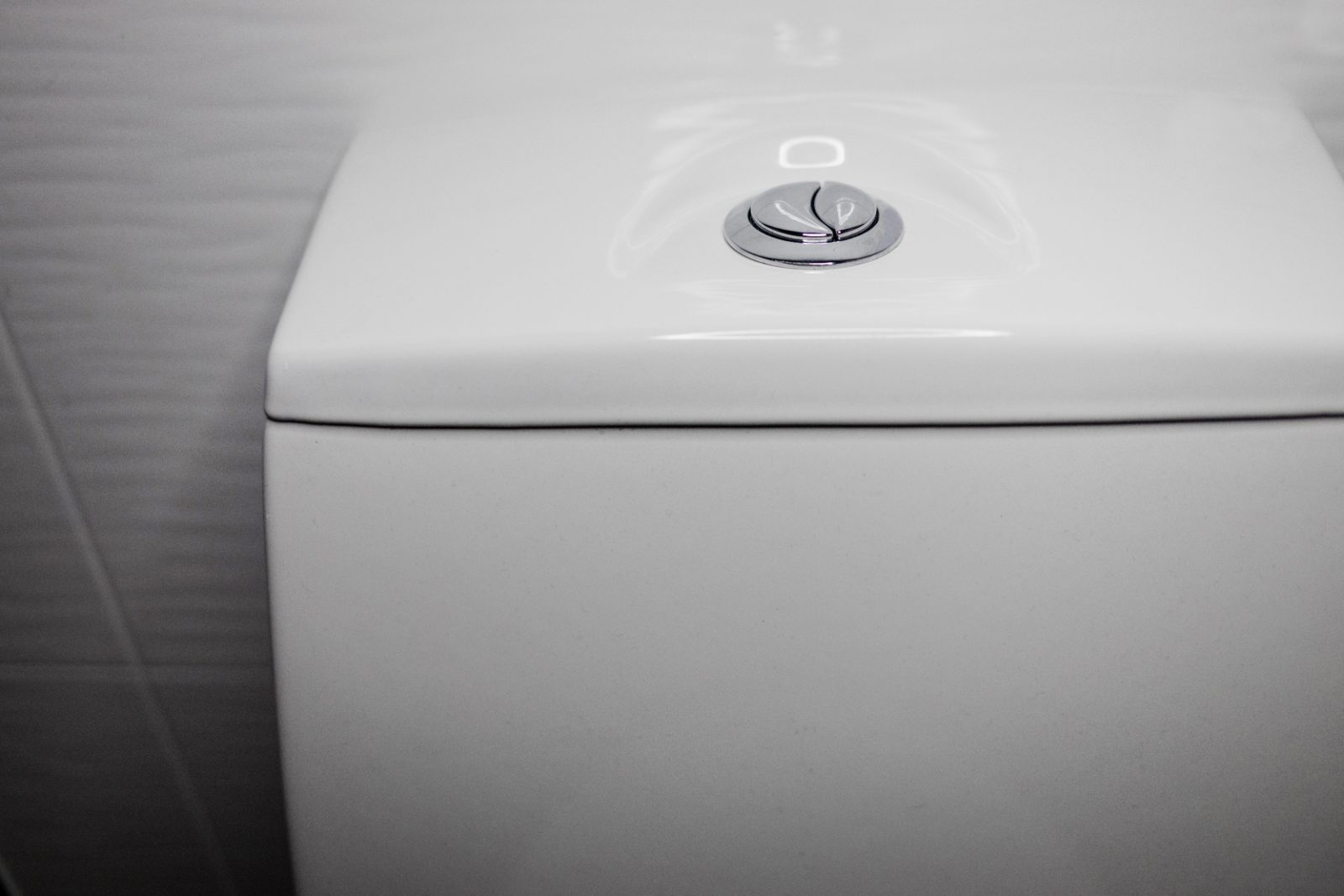
The button deserves singling out. Every person in the flat presses it, several times a day, usually on the way out of the room rather than on the way in. Treat it the way you treat a light switch or a door handle, which is to say wipe it, and wipe it often.
This is the one that surprises people. Standing up, the fixture looks perfectly fine. Crouch to knee height and you get a clear view of the back of the pedestal, the underside of the bowl where it curves in, and the line where porcelain meets tile. Three surfaces almost nobody reaches, all of them sitting closest to the floor.
Brush and flush last. Working in that order means nothing you have already cleaned gets dripped on, and whatever you put in the bowl has had the whole ten minutes to do something, which is roughly how a housekeeping visit works through a bathroom anyway.
There is a point past which a cloth is simply not the answer. If the grout around the base has gone dark and stays dark after it dries, or the sealant line where the pedestal meets the tile has turned from white to a patchy grey-black, that is not dirt sitting on top of a surface. It has gone into the material, and in Singapore that usually means mould rather than staining.

That is the moment to hand it over. Our mould removal team works on what has got into grout and sealant, floor deep cleaning takes on the tiled floor it is all standing on, and a deep clean goes at the whole bathroom rather than one fixture. Go and crouch down tonight, before the answer gets more complicated than a cloth and ten minutes, and when you have seen enough, book your next clean.


